Trypsin Enzyme Is Found in Which Juice: B2B Supplier Guide
Trypsin is a pancreatic juice enzyme. Learn how B2B buyers specify trypsin for cell culture, digestion, diagnostics, QC, and suppliers.
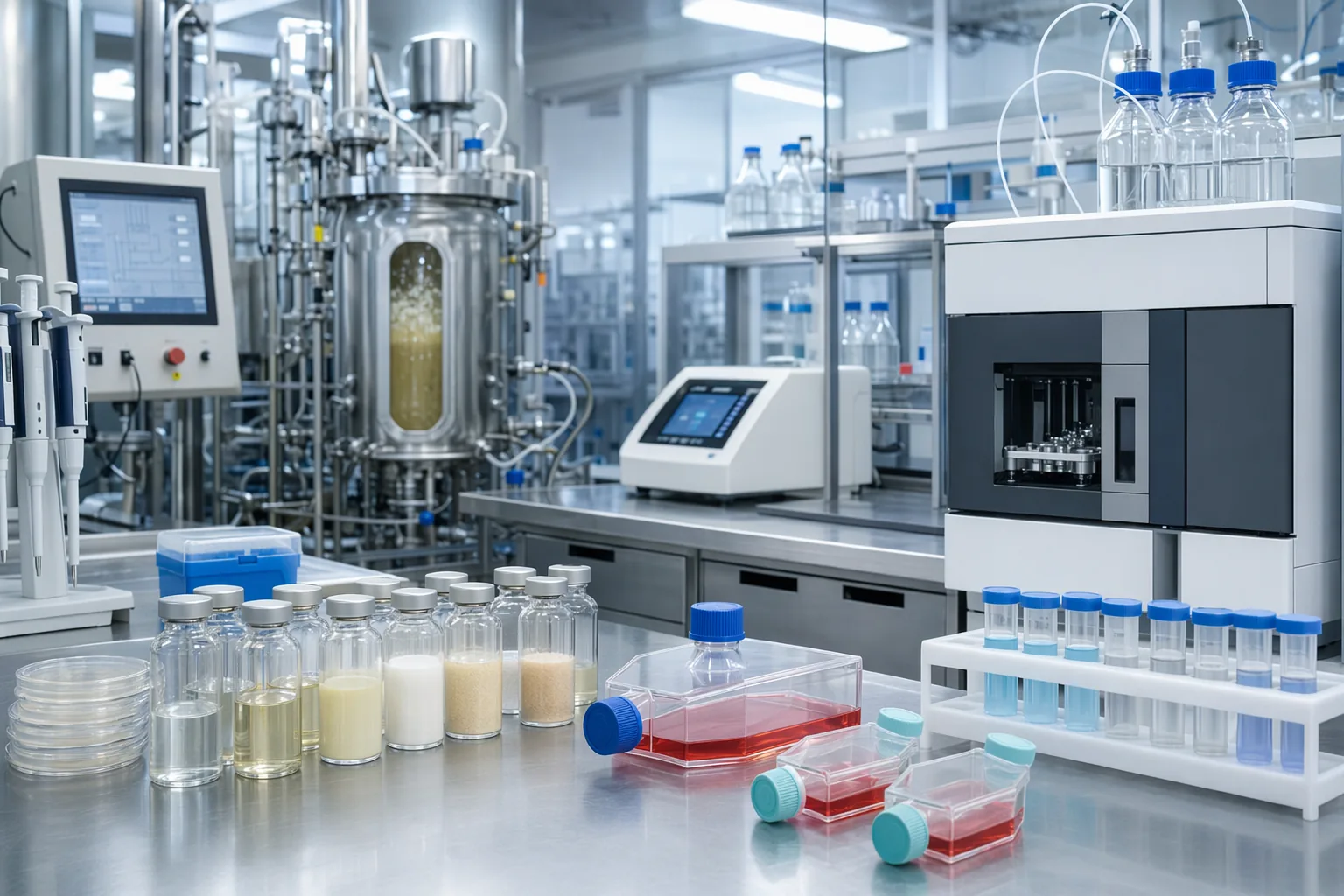
Trypsin is naturally associated with pancreatic juice, but industrial buyers source controlled trypsin enzyme preparations for cell culture, protein digestion, and diagnostic workflows.
What “Juice” Means for Trypsin Buyers
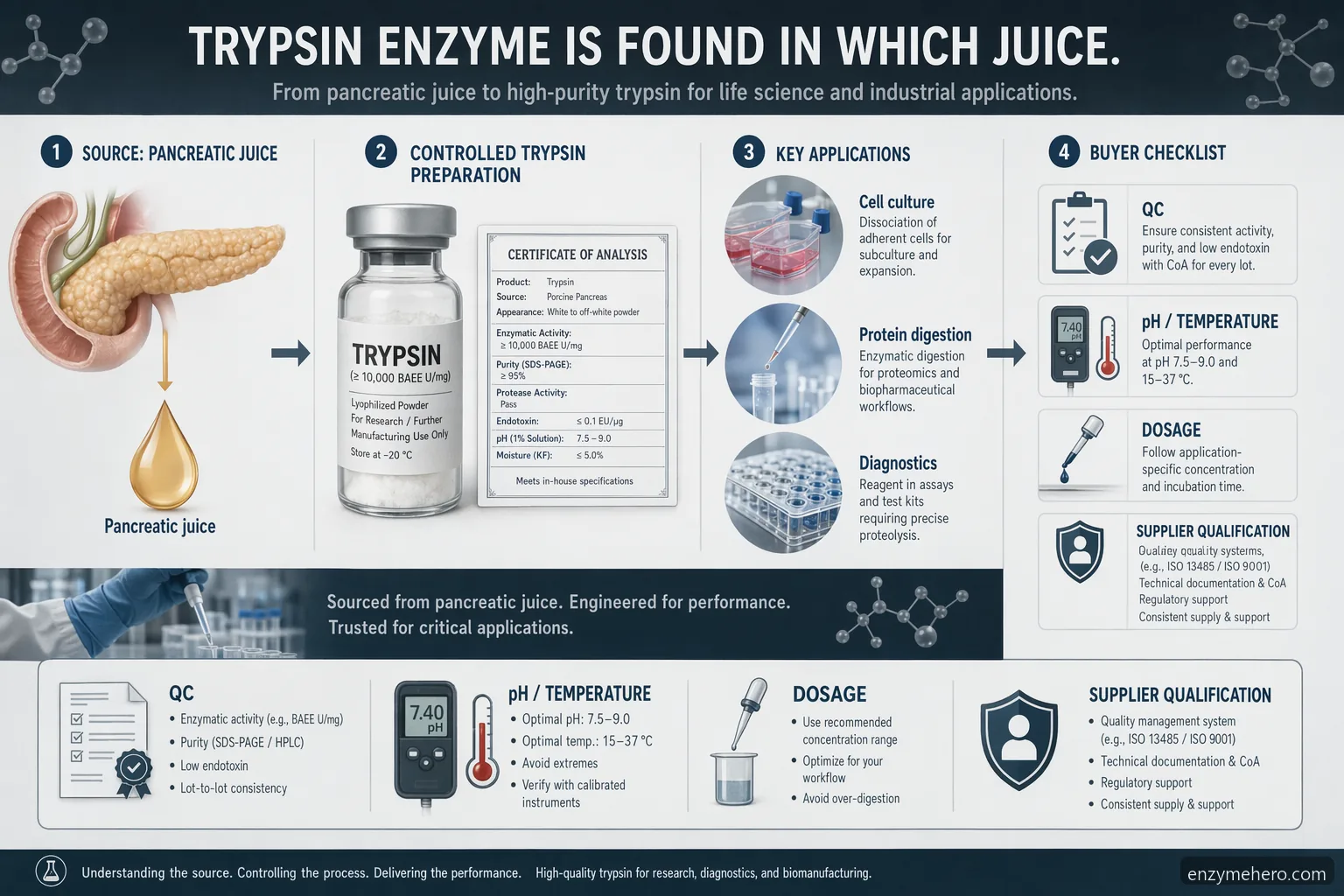
The focus keyword “trypsin enzyme is found in which juice” has a clear biological answer: trypsin is associated with pancreatic juice. In the body, the pancreas secretes inactive trypsinogen, and activation occurs after secretion into the small intestine. This distinction matters for industrial buyers because commercial trypsin is not purchased as a beverage or fruit-juice processing enzyme. It is specified as a controlled protease for applications such as cell culture detachment, protein digestion before analysis, and diagnostic reagent manufacturing. When evaluating a trypsin supplier, buyers should separate educational search intent from procurement criteria. The commercial decision should be based on activity units, source, purity, lot consistency, safety documentation, and performance in the buyer’s process matrix.
Natural location: pancreatic juice • Commercial format: purified or formulated trypsin enzyme • Primary B2B uses: cell culture, protein digestion, diagnostics
Industrial Uses of Trypsin Enzyme
Trypsin enzyme hydrolyzes peptide bonds mainly after lysine and arginine residues, making it useful where controlled protein cleavage is required. In cell culture, trypsin cell culture reagents are used to detach adherent cells from culture surfaces, often with EDTA to support detachment. In analytical workflows, trypsin supports reproducible protein digestion for peptide mapping and mass spectrometry sample preparation. In diagnostics, it may be used during antigen processing, reagent production, or controlled digestion steps, depending on the assay design. Recombinant trypsin is often considered when animal-origin risk reduction, supply consistency, or regulatory documentation is important. Buyers should qualify the enzyme in the actual buffer, substrate, temperature, and contact time used in production rather than relying only on catalog activity.
Cell culture detachment • Protein digestion and peptide mapping • Diagnostic reagent processing • Animal-derived or recombinant trypsin options
Process Conditions and Dosage Starting Points
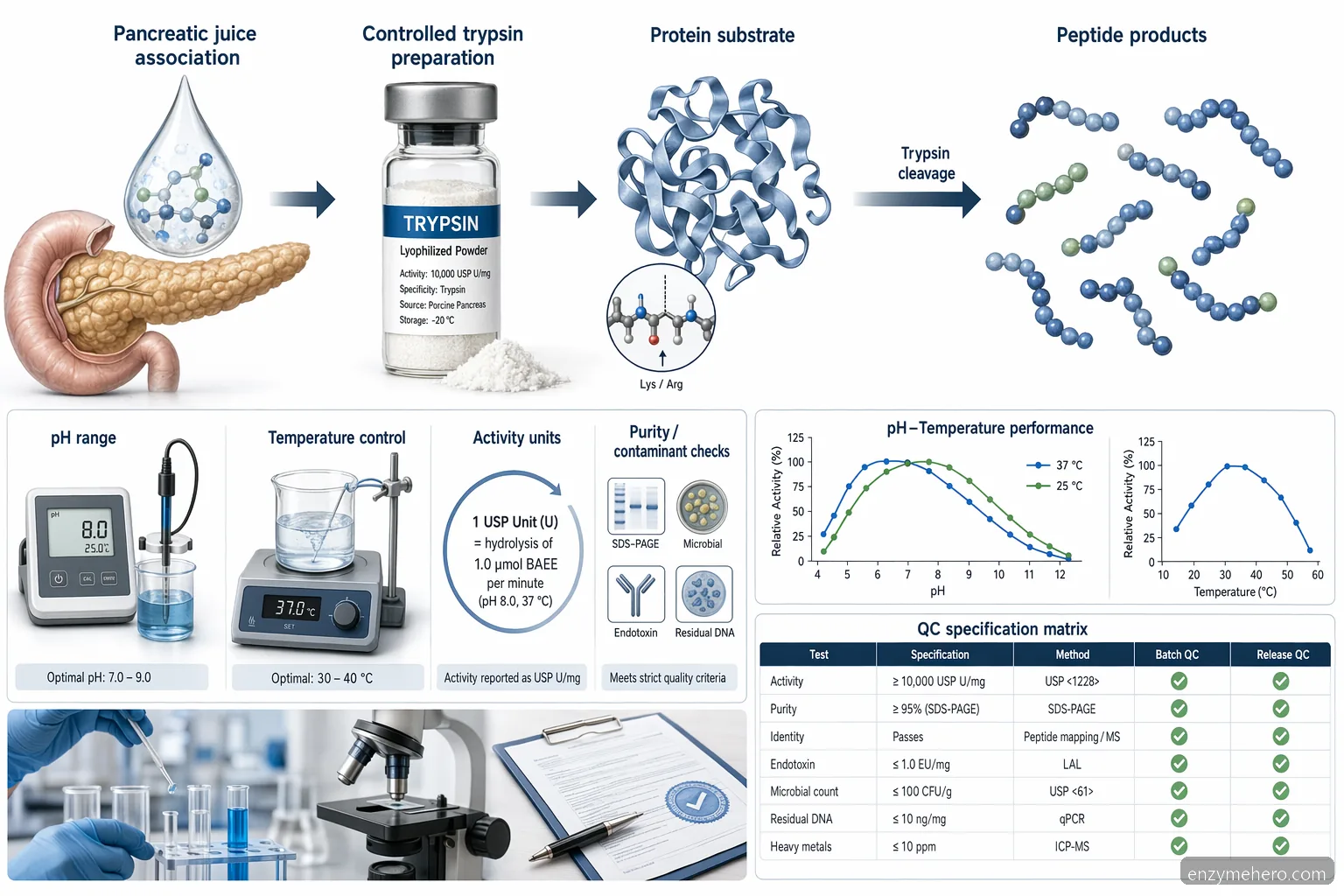
Trypsin typically performs best under mildly alkaline conditions, with many industrial and laboratory workflows using pH 7.5-9.0. Temperature is commonly 25-37°C, depending on whether the goal is gentle cell detachment or efficient protein digestion. Cell culture formulations often fall around 0.025-0.25% w/v trypsin, but exposure time should be minimized and validated for each cell line. Protein digestion protocols often start near enzyme-to-substrate ratios of 1:20 to 1:100 w/w, then optimize for completeness, missed cleavages, and peptide integrity. For diagnostics, dosage is process-specific and should be locked through design of experiments, acceptance criteria, and lot-to-lot verification. Avoid over-digestion, uncontrolled contact time, and unvalidated pH shifts.
Typical pH: 7.5-9.0 • Typical temperature: 25-37°C • Cell culture starting band: 0.025-0.25% w/v • Protein digestion starting ratio: 1:20 to 1:100 w/w
QC Checks Buyers Should Require
A qualified trypsin enzyme supply should include documentation and test results that connect directly to your process risk. Request a COA for every lot, a TDS describing composition and recommended handling, and an SDS for safe storage and use. Depending on application, useful QC checks may include activity assay, purity profile, residual chymotrypsin or contaminating protease limits, moisture, appearance, microbial limits, endotoxin, sterility, and identity confirmation. For cell culture, evaluate detachment time, cell viability, morphology, and post-passage growth. For digestion workflows, track missed cleavages, peptide coverage, background autolysis peaks, and reproducibility. For diagnostics, confirm that enzyme treatment does not shift assay sensitivity, specificity, stability, or matrix tolerance.
COA, TDS, and SDS availability • Activity and purity testing • Endotoxin or sterility expectations when relevant • Lot-to-lot performance verification
Supplier Qualification and Cost-in-Use
For B2B procurement, the lowest price per gram is rarely the best basis for selecting trypsin. Compare suppliers by cost-in-use: required dosage, digestion time, yield, failed batch risk, filtration losses, storage stability, and labor impact. Ask for pilot validation samples from representative lots and run them against incumbent material under identical conditions. A reliable supplier should support technical questions, provide change notification practices, define shelf life and storage conditions, and offer consistent lead times. If recombinant trypsin is being considered, confirm expression system, animal-origin-free claims where applicable, and impurity controls without assuming equivalence. Final approval should include purchasing, quality, production, and technical stakeholders so that documentation and performance are both covered.
Evaluate pilot lots before scale-up • Compare cost per successful batch, not only unit price • Confirm change-control and lead-time expectations • Include quality and production teams in approval
Technical Buying Checklist
Buyer Questions
Trypsin enzyme is associated with pancreatic juice. The pancreas releases the inactive precursor trypsinogen, which is activated after secretion into the small intestine. For B2B purchasing, this biological answer should not be confused with fruit juice processing. Commercial trypsin is sourced as a controlled protease for cell culture, protein digestion, diagnostics, and related industrial workflows.
The enzyme trypsin is part of pancreatic juice in biological digestion. Industrial buyers normally purchase purified, formulated, or recombinant trypsin rather than pancreatic juice itself. The right purchasing specification should define activity units, source, purity, formulation, storage conditions, documentation, and application performance requirements.
Trypsinogen is converted to trypsin mainly by enteropeptidase, also known as enterokinase. Once some trypsin is formed, trypsin can also activate additional trypsinogen. In industrial supply discussions, this activation biology is useful background, but procurement should focus on the delivered trypsin activity, impurity profile, stability, and reproducibility of the commercial enzyme.
Trypsin is found in the digestive system as a pancreatic protease that functions in the small intestine after secretion from the pancreas. Commercially, trypsin enzyme is found in manufactured enzyme preparations used for cell culture detachment, controlled protein digestion, and diagnostic reagent workflows. Buyers should verify source, grade, and QC data rather than relying only on the general biological origin.
Pepsin is usually the odd enzyme in that list because it is a gastric enzyme associated with stomach digestion, while trypsin, chymotrypsin, and carboxypeptidase are pancreatic enzymes. For procurement, the distinction matters because pepsin and trypsin have different pH profiles, cleavage behavior, and process applications. They are not interchangeable without validation.
Trypsin digests proteins by cleaving peptide bonds, especially after lysine and arginine residues under suitable conditions. This specificity is why trypsin is widely used for protein digestion and peptide mapping. In cell culture, its proteolytic activity helps detach adherent cells, but exposure time and concentration must be controlled to avoid cell damage.
Related Search Themes
trypsin enzyme, enzyme trypsin is a part of which juice, which enzyme converts trypsinogen to trypsin, where is trypsin enzyme found, where is the enzyme trypsin found, which is the odd enzyme trypsin carboxypeptidase pepsin chymotrypsin
Trypsin for Research & Industry
Need Trypsin for your lab or production process?
ISO 9001 certified · Food-grade & research-grade · Ships to 80+ countries
Frequently Asked Questions
Trypsin enzyme is found in which juice?
Trypsin enzyme is associated with pancreatic juice. The pancreas releases the inactive precursor trypsinogen, which is activated after secretion into the small intestine. For B2B purchasing, this biological answer should not be confused with fruit juice processing. Commercial trypsin is sourced as a controlled protease for cell culture, protein digestion, diagnostics, and related industrial workflows.
Enzyme trypsin is a part of which juice?
The enzyme trypsin is part of pancreatic juice in biological digestion. Industrial buyers normally purchase purified, formulated, or recombinant trypsin rather than pancreatic juice itself. The right purchasing specification should define activity units, source, purity, formulation, storage conditions, documentation, and application performance requirements.
Which enzyme converts trypsinogen to trypsin?
Trypsinogen is converted to trypsin mainly by enteropeptidase, also known as enterokinase. Once some trypsin is formed, trypsin can also activate additional trypsinogen. In industrial supply discussions, this activation biology is useful background, but procurement should focus on the delivered trypsin activity, impurity profile, stability, and reproducibility of the commercial enzyme.
Where is trypsin enzyme found?
Trypsin is found in the digestive system as a pancreatic protease that functions in the small intestine after secretion from the pancreas. Commercially, trypsin enzyme is found in manufactured enzyme preparations used for cell culture detachment, controlled protein digestion, and diagnostic reagent workflows. Buyers should verify source, grade, and QC data rather than relying only on the general biological origin.
Which is the odd enzyme: trypsin, carboxypeptidase, pepsin, chymotrypsin?
Pepsin is usually the odd enzyme in that list because it is a gastric enzyme associated with stomach digestion, while trypsin, chymotrypsin, and carboxypeptidase are pancreatic enzymes. For procurement, the distinction matters because pepsin and trypsin have different pH profiles, cleavage behavior, and process applications. They are not interchangeable without validation.
The enzyme trypsin digests which type of substance molecule?
Trypsin digests proteins by cleaving peptide bonds, especially after lysine and arginine residues under suitable conditions. This specificity is why trypsin is widely used for protein digestion and peptide mapping. In cell culture, its proteolytic activity helps detach adherent cells, but exposure time and concentration must be controlled to avoid cell damage.
Related: Trypsin Enzyme for Reliable Cell Harvesting
Turn This Guide Into a Supplier Brief Request trypsin COA, TDS, SDS, pricing, and pilot samples for your validated workflow. See our application page for Trypsin Enzyme for Reliable Cell Harvesting at /applications/trypsin-enzyme-substrate/ for specs, MOQ, and a free 50 g sample.
Contact Us to Contribute